

Earlier research · 2018–2020
Learning without backpropagation through time (RSM)
How we got here
- 2019
- 2020An Nguyen, Masters · Monash RL for attentional strategiesAbout An’s project →RL to learn attentional strategies for RSM
Project notes
Reinforcement learning of attentional strategies (2019-2020)
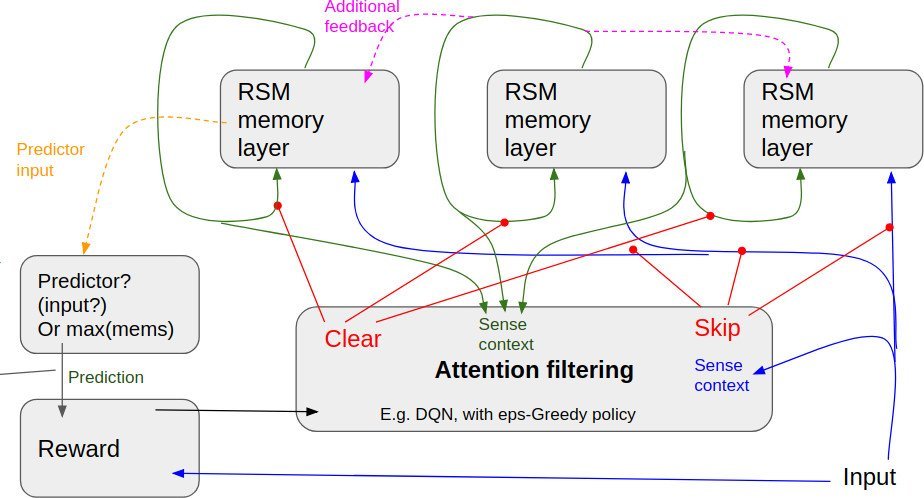
Recently Transformers and other attentional neural architecture have shown great promise in a number of domains. How can we align the deep backpropagation used in Transformers with our desire to use biologically plausible local credit assignment? We aim to use the Bellman equation – better known as discounted Reinforcement Learning – to learn attentional strategies for controlling a set of RSM memory “heads” such that their predictive abilities are maximized.
Learning distant cause & effect with only local credit assignment (2018-2019)
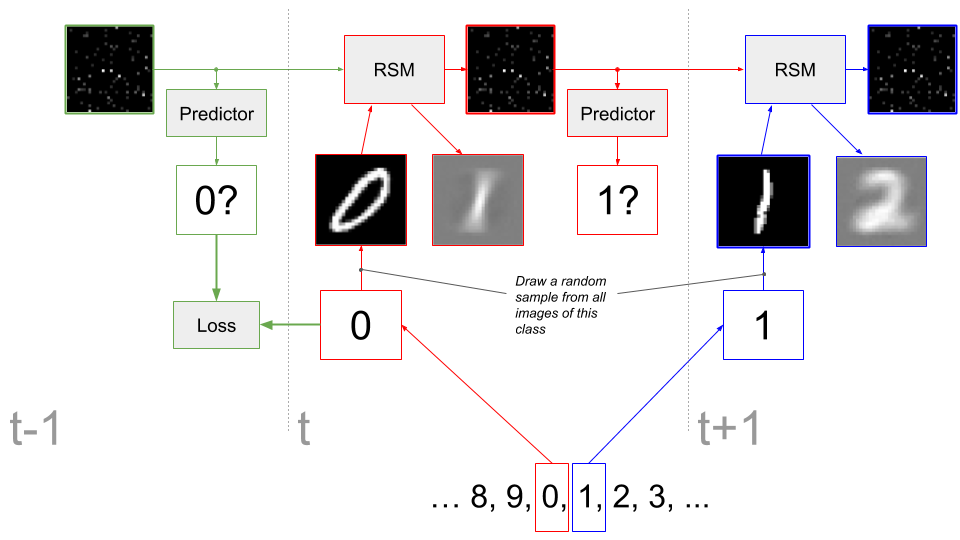
In May we introduced our Recurrent Sparse Memory (RSM). We showed that it can learn to associate distant casuses and effects, higher-order and partially observable sequences, and also tested it on natural language modelling. RSM is demonstrated to possess capabilities that previously required deep backpropagation and gated memory networks such as LSTM, while using more computationally and memory efficient local learning rules.
Alternatives to BackPropagation Through Time (BPTT)
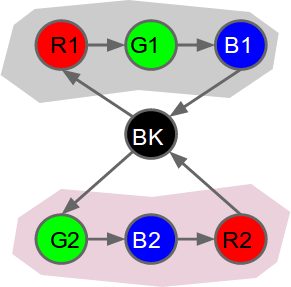
We are intensely interested in biologically plausible alternatives to backpropagation through time (BPTT). BPTT is used to associate causes and effects that are widely separated in time. The problem is that it requires storage of partial derivatives for all synaptic weights for all time-steps up to a fixed horizon (e.g. 1000 steps). Not only is this memory intensive, the finite time window is very restrictive. There is no neurological equivalent to BPTT – nature does it another way, which we hope to copy.
This project led to the development of our RSM algorithm.